


Building a simple AI agent is easy. We have all seen the impressive weekend projects. You hook up a language model to a couple of API endpoints, write a quick prompt, and suddenly you have a working demo. It looks smart, it works on your machine, and it makes for a great slide deck.
But when you try to take that same prototype and run it inside a real business, things quickly fall apart.
In a demo, everything is clean. Your input data is perfect, your APIs respond instantly, and the user follows a simple, predictable path. Production is completely different. Your agent is thrown into a messy world of broken spreadsheets, emails that lack context, and networks that constantly time out.
For CTOs, CIOs, and engineering leaders, getting an agent to work in production is not about writing clever prompts. It is about treating these systems like complex, distributed, probabilistic software. It requires a serious architectural blueprint. This guide is a practical reference manual for building AI agents that are secure, measurable, and truly dependable.
1. Why Successful Demonstrations Fail in Production
The industry is currently facing a quiet crisis. Only 12% of enterprise AI agent projects successfully make the transition from pilot to sustained production. The remaining 88%
stall or are abandoned, costing companies an average of $340,000 in direct losses per failed project in wasted engineering hours, infrastructure overhead, and integration complexity.
These failures are structural, not model problems. If we look at telemetry data across hundreds of enterprise deployments, projects stall for seven predictable reasons:
| Failure Pattern | Frequency | Core Failure Mechanism |
| Scope Creep | 34% | Adding more and more requirements turns a simple task into an open-ended logic puzzle. This creates too many possible execution paths, making the system incredibly hard to test or debug. |
| Data Quality Failures | 27% | Encountering real-world data with missing fields, messy formatting, duplicates, or outdated information. This leads to a chain of errors across multi-step tasks. |
| Security Blockers | 14% | Rejection by risk and security teams during final audits because the system lacks audit logs, clear access control boundaries, or defenses against prompt injections. |
| Integration Complexity | 9% | Fragile API connections, mismatching schemas, and network errors in legacy systems that cause silent data corruption or system hangs. |
| Cost Overruns | 7% | Uncontrolled token usage caused by recursive logical loops and redundant tool calls under high volumes. |
| Governance Gaps | 5% | Project abandonment after the first major unexpected behavior because there is no clear ownership, operational dashboard, or rollback plan. |
| Organizational Resistance | 4% | Lack of change management, poor integration with human workflows, and misalignment with existing performance metrics. |
Combined, scope creep and data quality failures cause 61% of all project collapses. Data quality is particularly dangerous for agent systems because of the Step Reliability Tax.
Traditional software fails loudly and clearly by throwing an error or crashing. An autonomous agent, however, is a probabilistic system. If an agent gets incomplete or messy inputs, it does not crash. Instead, it chains multiple incorrect decisions together. This error propagation causes the agent to perform a series of invalid tool actions, which can corrupt databases before anyone notices.
Mathematically, if an agent has a single-step success rate of p, the probability of completing a workflow of n steps without a cascading error is:
P(Workflow Success) = pⁿ
When p = 0.95 (95% single-step accuracy), a 10-step workflow has a success rate of only 60%. If single-step accuracy drops to p = 0.90, the end-to-end success rate collapses to 35%.
At twenty steps, even an exceptionally accurate 99% model fails nearly 1 in 5 times. To eliminate this sandbox illusion, our Custom AI Engineering services shift the focus from optimistic prompt engineering to rigid, code-enforced behavioral boundaries, isolating agent capabilities to ensure predictability.
End-to-end success falls quickly as the number of steps grows:
| Single-step accuracy (p) | 5 steps | 10 steps | 15 steps | 20 steps |
| 99% | 95.1% | 90.4% | 86.0% | 81.8% |
| 95% | 77.4% | 59.9% | 46.3% | 35.8% |
| 90% | 59.0% | 34.8% | 20.6% | 12.2% |
2. The Anatomy of an Enterprise AI Agent
An enterprise-grade autonomous system requires a fundamental shift away from simple chatbot interfaces. Chatbots operate on a stateless request and response pattern, taking a single text prompt and generating text before stopping. An autonomous agent is designed to break down complex tasks, interact with external systems, maintain long-term context, and continually evaluate its own progress.
This cognitive architecture operates over a continuous Observe, Plan, and Act cycle, consisting of six core components:
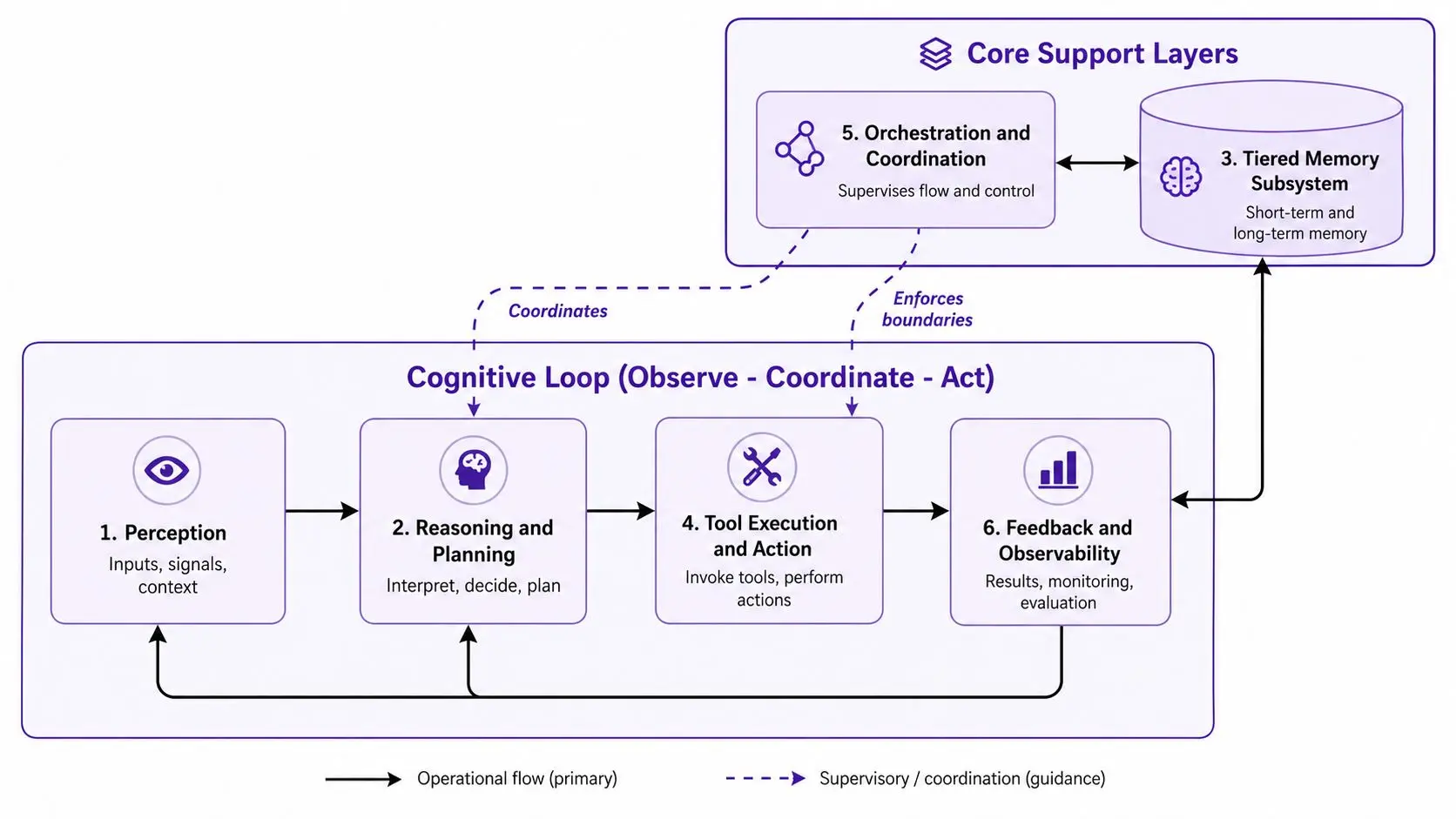
Perception: The sensory interface that ingests raw data from unstructured documents, database events, and API payloads, translating them into structured internal data.
Reasoning and Planning: The cognitive module that breaks a high-level goal into smaller sub-goals. It uses sequential logic processing to evaluate choices and adapts plans based on feedback.
Memory Subsystem: A tiered storage system modeled after cognitive operating systems. Working memory keeps temporary execution states and short-term variables needed for the immediate task. Procedural memory stores the operational instructions, learned skills, and routing rules. Declarative memory contains factual knowledge and records of historical interactions retrieved across multiple sessions.
Tool Execution and Action: The system actuators. These are standardized interfaces, like REST endpoints, databases, and microservices, that allow the agent to execute changes in external systems.
Orchestration and Coordination: The underlying runtime engine that schedules execution steps, tracks the queue, manages data flow, and enforces system-wide limits.
Feedback and Observability: The validation and monitoring layer that tracks performance, measures semantic similarity, catches execution loops, and secures audit trails.
By building these six layers into our managed platform, our Managed AI Services ensure that your agent operations remain strictly bounded, preventing agent sprawl where untracked automations run with broad permissions on sensitive databases.
3. Model and Tool Orchestration
To build predictable and reliable systems, enterprise architectures must separate concerns. Agents decide, orchestrators coordinate, and tools execute. Allowing models to autonomously handle system flow, execution sequences, and retry logic is a primary driver of production failures.
When designing the orchestration layer, engineering leaders must decide where state ownership resides. In production, a hybrid state ownership model is the enterprise standard.
Comparing State Ownership Models in Production
| Architectural Property | Centralized Orchestration | Decentralized Orchestration | Hybrid State Ownership (Enterprise Standard) |
| Control Model | A single controller, like a deterministic state machine, directs all steps. | Peer-to-peer negotiation where individual agents route actions autonomously. | A centralized orchestrator enforces policies and transitions, while local agents run autonomous logic inside strict boundaries. |
| Auditability | Excellent; a single execution log captures all state transitions. | Complex; requires reconstructing distributed trace spans across systems. | High; global transitions are logged centrally, while localized paths are captured inside traces. |
| Cost & Latency | Highly predictable; strict limit caps can be enforced programmatically. | Low predictability; susceptible to agent loops and token-burn cascades. | Balanced; token budgets and time limits are enforced centrally while optimizing local tasks. |
| Failure Isolation | High; tool failures can be caught and mitigated centrally. | Low; failures can cascade across multi-agent handoff points, causing state corruption. | Maximum; failures are safely contained within the local agent, triggering deterministic central rollbacks. |
To implement this hybrid standard, we build four orchestration patterns into the system core:
Deterministic State Machine Orchestration: The primary workflow must be coded as a deterministic state machine using state charts or workflow engines, rather than relying on a model to navigate the steps. The model is called only within a specific state to resolve an explicit, bounded question, like classifying user intent. The output is then mapped back into a defined state transition.
Supervisor and Specialists Pattern: Rather than loading an agent with a large, general-purpose prompt containing descriptions of all enterprise tools, the architecture divides responsibilities among specialized micro-agents. A centralized Supervisor agent parses incoming tasks and delegates them to dedicated Specialist agents. This approach prevents prompt bloat, reduces latency, and narrows security exposure.
Tool Contracts via Strict Schemas: Tools must never be exposed to models as free-form capabilities. Instead, every tool must implement a strict, statically typed schema, using validation frameworks like Pydantic, to enforce exact input types, default values, and semantic bounds. The tool adapter must reject execution requests containing unrecognized arguments, enforcing a fail-closed paradigm.
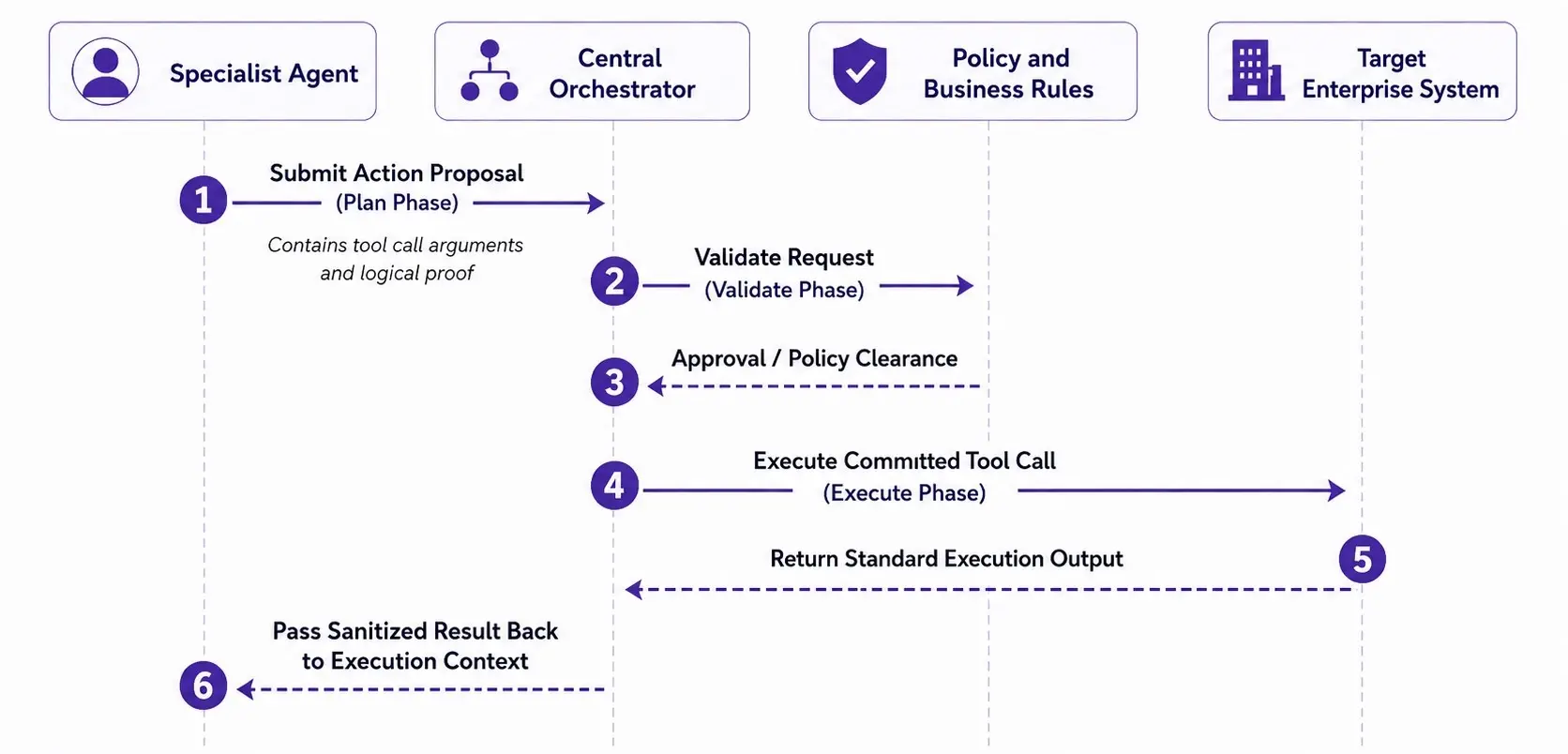
Two-Phase Actions (Plan-Validate-Execute): To prevent agents from executing irreversible actions based on errors, the orchestrator enforces a two-phase execution cycle. First, in the Plan Phase, the agent generates a structured proposal outlining the desired tool call and parameters. Second, in the Validate Phase, the orchestrator intercepts the proposal and runs it through policies, business rules, and human gates. Third, in the Execute Phase, the action is committed to the external system only after all validations pass.
4. RAG, Memory, and Enterprise Data Access
A production-grade AI agent requires access to enterprise knowledge. To support this, system developers must understand the architectural distinction between Retrieval-Augmented Generation (RAG) and stateful AI memory systems. While both layers inject context into the execution loop, they solve different operational challenges, rely on different infrastructure, and fail in different ways.
Differences Between RAG and Stateful Memory Systems
| Feature Parameter | Retrieval-Augmented Generation (RAG) | Stateful AI Memory Subsystems |
| Design Objective | Injecting domain-specific, factual, and static knowledge into the model context. | Maintaining continuous context, user preferences, and task progression across sessions. |
| State & Write Properties | Stateless; reads from a static index and resets completely at the end of a session. | Stateful; actively reads and writes contextual updates to persistent storage across sessions. |
| Freshness Latency | Batch-updated; relies on scheduled pipelines to re-index enterprise source databases. | Real-time updated; learns directly from human interactions and execution trace outcomes. |
| Infrastructure Focus | Document chunking, semantic vector stores, and hybrid retrieval indexes. | Graph databases, low-latency key-value caches, and stateful relational checkpoint stores. |
The current consensus among practitioners is that using vanilla RAG as an agent memory mechanism fails. RAG is a read-only retrieval pipeline and is structurally incapable of handling session continuity. More critically, studies show that 60% of enterprise AI projects are abandoned due to context and data readiness gaps rather than retrieval mechanics.
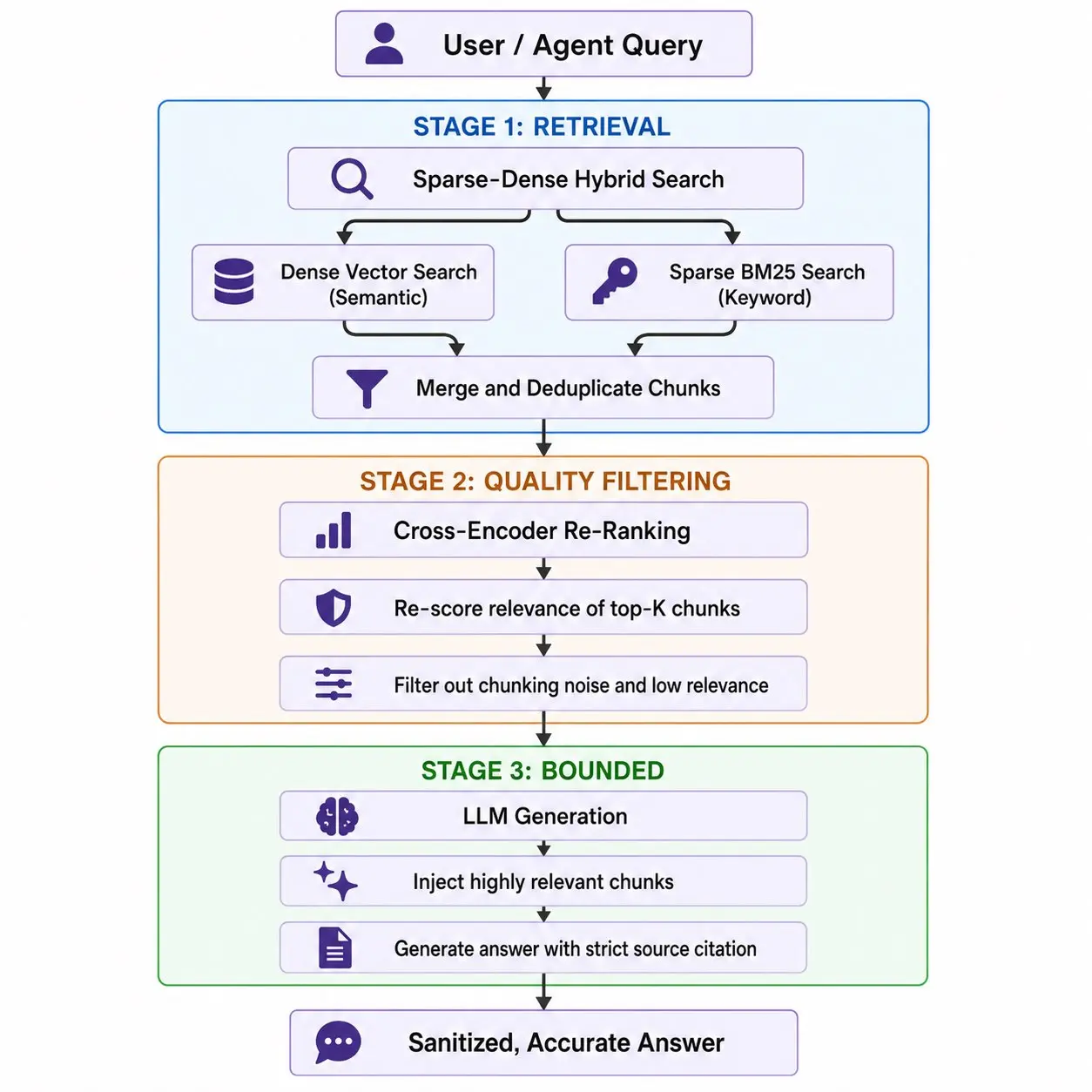
High-performance agentic RAG requires an enterprise data access layer built on a three-stage retrieval pipeline:
Stage 1: Sparse-Dense Hybrid Search: Executes parallel vector similarity search (dense retrieval) and BM25 keyword search (sparse retrieval) across enterprise document indexes, capturing both semantic intent and exact phrase matches.
Stage 2: Cross-Encoder Re-Ranking: Passes the top retrieved chunks through a cross-encoder model to re-score and re-rank document relevance, filtering out vector noise and chunking artifacts.
Stage 3: LLM Generation: Injects the highly refined context into the prompt, utilizing strict citation tagging and reference anchors, like document ID and page number, to block downstream hallucinations.
To further prevent memory poisoning, where a compromised document in a vector corpus corrupts the model’s factual grounding, our Custom AI Engineering teams integrate advanced RAG with structured metadata governance and automatic data validation rules, ensuring the agent only consumes certified enterprise data.
5. Identity, Permissions, and Security Controls
The moment an AI agent moves past read-only queries and is granted tool-use capabilities, it introduces severe security vulnerabilities. OWASP identifies Excessive Agency as a critical security risk, which occurs when an agent holds more functionality, permissions, or autonomy than its task requires.
Security architects must enforce unique Workload Identities. AI agents must never borrow shared human credentials or system-wide service accounts. Each deployed agent version and environment must have its own cryptographic identity, such as OAuth 2.1 client credentials or SPIFFE-compatible workload identities. When an agent executes an action for a human, it must utilize an On-Behalf-Of (OBO) token exchange (RFC 8693), ensuring the agent’s effective permissions can never exceed the delegating user’s authorization.
Model Context Protocol (MCP) Security Architecture
The Model Context Protocol (MCP) has become a common standard for connecting language models to external resources. However, MCP introduces two severe, protocol-specific security risks:
- malicious third-party MCP server can inject adversarial instructions directly into these descriptions, like telling the model to always export data first. When the model ingests these tool descriptions, it executes the malicious instructions as part of its logical context.
- The Stdio Transport Visibility Gap: MCP commonly relies on two transport types: Streaming HTTP (for remote servers) and Stdio transport (where the server is launched as a local sub process, communicating over standard input and output). Because stdio communication occurs entirely in local memory and never touches the network card, traditional network firewalls, logging proxies, and API gateways are completely blind to these tool calls.
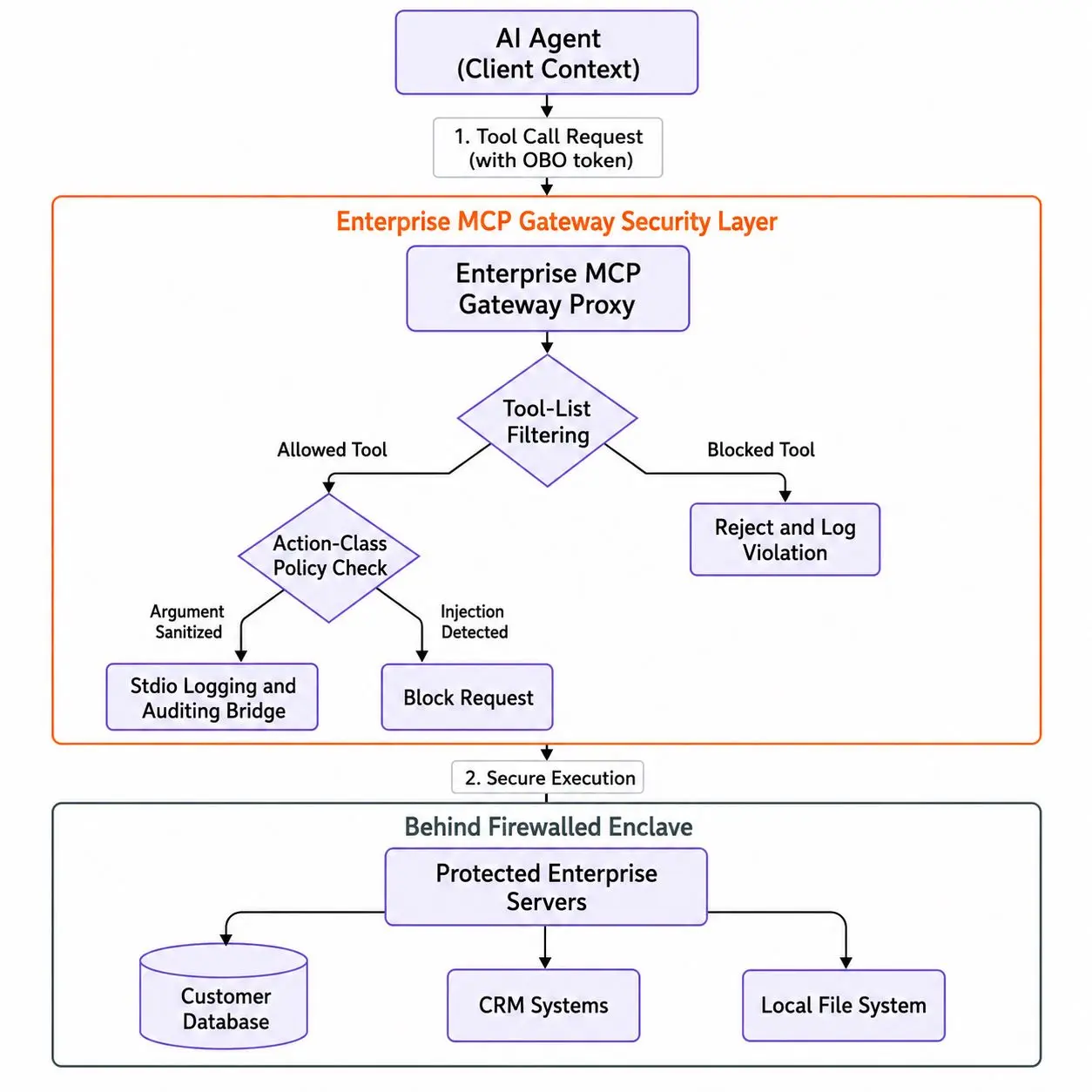
To secure MCP integrations, organizations must deploy an Enterprise MCP Gateway to act as a semantic proxy between the agent and protected backend servers.
Comparing Enterprise Gateway Architectures
| Security Feature | Traditional API Gateway | LLM Gateway | Enterprise MCP Gateway |
| Primary Protocol | HTTP/REST, GraphQL, or gRPC. | HTTP/REST. | Model Context Protocol (MCP). |
| Primary Security Focus | Rate limiting, JWT validation, and Web Application Firewalls (WAF). | PII redaction and prompt injection blocking. | On-behalf-of (OBO) token exchange, tool-list filtering, and runtime action execution policy. |
| Payload Awareness | Structured JSON payloads. | Unstructured text prompts and completions. | Dynamic tool schemas and function execution arguments. |
| Enforcement Layer | Transport and HTTP layer. | Prompt and model access layer. | Tool and agent behavior layer. |
| Core Use Case | Exposing static APIs to internal and external microservices. | Managing centralized model API keys and rate limits. | Governing autonomous agent access to external enterprise tools. |
The Enterprise MCP Gateway enforces three critical security primitives:
- Tool-List Filtering: The gateway intercepts the tool list advertised by connected servers. It dynamically rewrites the schema response, filtering out destructive capabilities before the schema ever reaches the model’s context window, neutralizing tool-poisoning attacks.
- Action-Class Enforcement: The gateway inspects the payload arguments of every tool call at runtime, blocking unauthorized operations, like blocking an update statement sent through a generic database tool during a read-only task.
- Stdio Transport Auditing: The gateway bridges local stdio subprocess communication to a secure logging plane, ensuring that every tool call, context transfer, and data exchange is captured in the central audit trail.
6. Human Approval and Exception Handling
A common mistake in agent development is setting up confidence-based escalation, where an agent is allowed to execute actions unless its reported confidence score falls below a certain threshold. However, model confidence is systematically miscalibrated.
Models trained with Reinforcement Learning from Human Feedback (RLHF) tend to express the highest verbal confidence on incorrect or hallucinated outputs. Empirically, a claimed 90% confidence frequently corresponds to only a 75% real-world accuracy. When multiple agents are chained together, this miscalibration compounds. A three-agent chain operating with a real accuracy of 42.2% is an operational liability.
Human-in-the-loop (HITL) gates must therefore be governed by deterministic, code-enforced Action-Risk Tiers rather than model-generated confidence signals:
- Tier 1: Read-Only (Fully Autonomous): Actions with no side effects on the external world, such as retrieving public documents, running local lookups, or executing semantic search queries. These actions run without interruption to avoid confirmation fatigue.
- Tier 2: Reversible (Autonomous with Logging): Actions that modify state but can be cleanly undone, such as drafting an email, updating an internal ticket status, or creating a staging record. The agent executes these actions autonomously but logs the change with a complete transaction record to enable manual reversal.
- Tier 3: External / Third-Party (Confidence Routed): Actions that interact with external services, such as checking flight schedules or query-parsing partner databases. These are routed based on holistic trajectory calibration metrics, sending borderline cases to an asynchronous review queue.
- Tier 4: High-Risk / Irreversible (Mandatory Human Approval): Actions that alter production states, move financial capital, delete data records, modify security privileges, or dispatch external communications to clients. These actions require mandatory human approval, regardless of the agent’s reported confidence level.
The Durable Execution Pattern
In real-world cloud environments, synchronous approvals fail. Holding an active HTTP connection or a serverless container open while waiting minutes, hours, or days for a human operator to click approval triggers gateway timeouts and causes authentication tokens to expire.
To resolve this, developers must implement a Durable Execution Pattern. When an agent reaches a Tier 4 action, the workflow pauses. Stateful executors, like custom request ports or durable fibers, serialize the agent’s current call stack, state variables, and token cache, writing them as a checkpoint to a database. The active runtime thread is safely terminated.
The system emits an information request event containing a plain-language summary of the action and a side-by-side diff of proposed changes. Once the human approves or edits the request, the orchestrator reads the checkpoint database, re-hydrates the state, and resumes execution, guaranteeing zero state loss or connection timeouts.
7. Evaluation Before Deployment
Traditional software testing relies on deterministic assertions where a specific input must yield an identical, predictable output. This paradigm is insufficient for evaluating non-deterministic, multi-step AI agents. An agent may achieve a correct final answer through an inefficient sequence of tool calls, or arrive at an incorrect answer despite following a logical plan.
Testing only the final output obscures these issues, leading to cascading errors, inefficient execution paths, and silent system failures in production. To address this, enterprise engineering teams must evaluate the entire execution trajectory, which is the sequential path of planning, tool selection, parameter construction, and memory access.
System metrics must be mapped across four distinct architectural layers:
Trajectory Evaluation Metrics by Layer
| Evaluation Layer | Core Metric | Focus Area & Technical Measurement Method |
| Logic Layer | Plan Quality | Evaluates planning completeness using a separate model-as-judge with a standardized rubric. |
| Plan Adherence | Alignment between plan and execution, measured via a sequence alignment score of tool paths. | |
| Tool Selection Accuracy | Precision and recall metrics comparing selected tool names against ground-truth labels. | |
| Action Layer | Tool Correctness | Evaluates tool validation and safety: valid names, correct input types, and schema compliance. |
| Argument Correctness | Parameter extraction accuracy, verified using schema validation and deterministic parsing. | |
| Path Validity | Structural execution integrity, evaluated using graph analysis of trace files to catch infinite loops. | |
| End-to-End Layer | Task Completion Rate | Overall goal achievement, verified using exact-match checks or model-as-judge evaluation. |
| Step Efficiency | Trajectory resource optimization, calculated as the ratio of optimal path length to actual steps. | |
| Cost & Latency | Financial and time resource consumption, evaluated by tracking exact token usage and latency. | |
| Safety & Policy | Injection Resilience | Defense against adversarial prompts, tested using red-teaming test suites with hidden payloads. |
| Policy Adherence Rate | Compliance with business guidelines, evaluated using model-as-judge audits of system outputs. |
Building a deployment evaluation harness requires a structured, five-step implementation process:
- Define Explicit Success Criteria: Establish measurable definitions of working correctly for every skill, tool, and sub-task before writing agent code.
- Create a Representative Test Suite: Build a test suite that spans happy-path cases, edge cases like missing fields and malformed dates, and adversarial prompt injections.
- Instrument Complete Tracing: Configure tracing across all components using OpenTelemetry standards. Capture the exact payload, latency, and token consumption of every individual span.
- Deploy Dual Evaluation Methods: Combine fast, deterministic code assertions for schemas, argument types, and JSON parsing with model-as-judge frameworks for qualitative dimensions like tone, planning quality, and safety policy compliance.
- Establish Automated CI/CD Gates: Integrate the evaluation harness directly into your continuous integration pipeline. Trigger automated regression runs on every prompt modification or tool schema change to block deployments that degrade system quality.
8. Production Monitoring for Quality, Latency, and Cost
Monitoring an autonomous, non-deterministic agent requires infrastructure-level telemetry that extends far beyond traditional CPU and memory tracking. Production dashboards must track five core telemetry dimensions to detect agent decay and operational anomalies:
Production Telemetry and Quality Metrics
| Telemetry Metric | Target Threshold | Monitoring Protocol |
| Retrieval Quality | ≥ 85% Accuracy | Automated evaluation of retrieved document relevance against incoming user search queries. |
| Answer Accuracy | ≥ 90% Factual Score | Periodic model-as-judge and human evaluations comparing outputs against source data citations. |
| Response Performance | p95 Latency < 5s | Continuous instrumentation of server response timestamps and API round-trip times. |
| User Satisfaction | > 80% Satisfaction | Real-time tracking of UI click events, thumbs-up rates, and conversational session frequency. |
| Knowledge Coverage | < 10% Fallback Rate | Automated parsing of model fallback strings and zero-match search results. |
In addition to dashboards, the system runtime must enforce three infrastructure-level controls to prevent runaway costs, resource exhaustion, and infinite loops:
- Stuck-Loop Detection: Non-deterministic models are prone to stuck loop behaviors where they repeatedly execute the same tool call when encountering an unexpected error payload. The infrastructure layer must monitor the execution trace for cyclic tool patterns. If a specific tool name is invoked with identical parameters more than three times without modifying state, the orchestrator must trip a circuit breaker, halt execution, and escalate to a human operator.
- Context Window Proximity Warnings: Long-running agent sessions can quickly saturate the model’s context window with redundant data, leading to silent truncation and decision-making on incomplete information. The orchestrator must track active token consumption programmatically. The system should inject explicit instructions, such as asking the agent to summarize history and close the task, when token usage crosses 70% and 90% of the context limit, ensuring the agent terminates the workflow gracefully before truncation occurs.
- Strict Token and Budget Caps: To defend against runaway financial costs from unmonitored execution loops, every task execution must carry a strict token budget and a hard limit on sequential tool execution cycles, such as a maximum of twenty steps or $5.00 in execution cost. Once a budget cap is breached, the execution thread is automatically terminated.
Our Cloud Runway infrastructure is custom-built with these runtime controls baked directly into the compute layer, providing a secure, high-performance sandbox that automatically caps runaway execution costs before they hit your balance sheet.
9. Incident Response and Rollback
When an agentic system fails in production, standard application rollbacks, like redeploying an older container, are insufficient. Because agents have tool access, their failures involve real-world side effects, including corrupted database rows, duplicate CRM entries, or unauthorized access changes. Enterprise architectures must implement two resilient design patterns to handle these incidents: Quality-Aware Circuit Breakers and Idempotent Sagas.
Quality-Aware Circuit Breakers (LLM-Specific)
Traditional infrastructure circuit breakers monitor HTTP status codes, opening the circuit to stop traffic when a service degrades. This model is inadequate for AI agents. If an LLM provider degrades or a prompt is misconfigured, the API gateway may continue to return standard 200 OK status codes while the model confidently outputs malformed JSON, hallucinates tool parameters, or violates safety policies.
A Quality-Aware Circuit Breaker tracks semantic and schema failures at the execution layer:
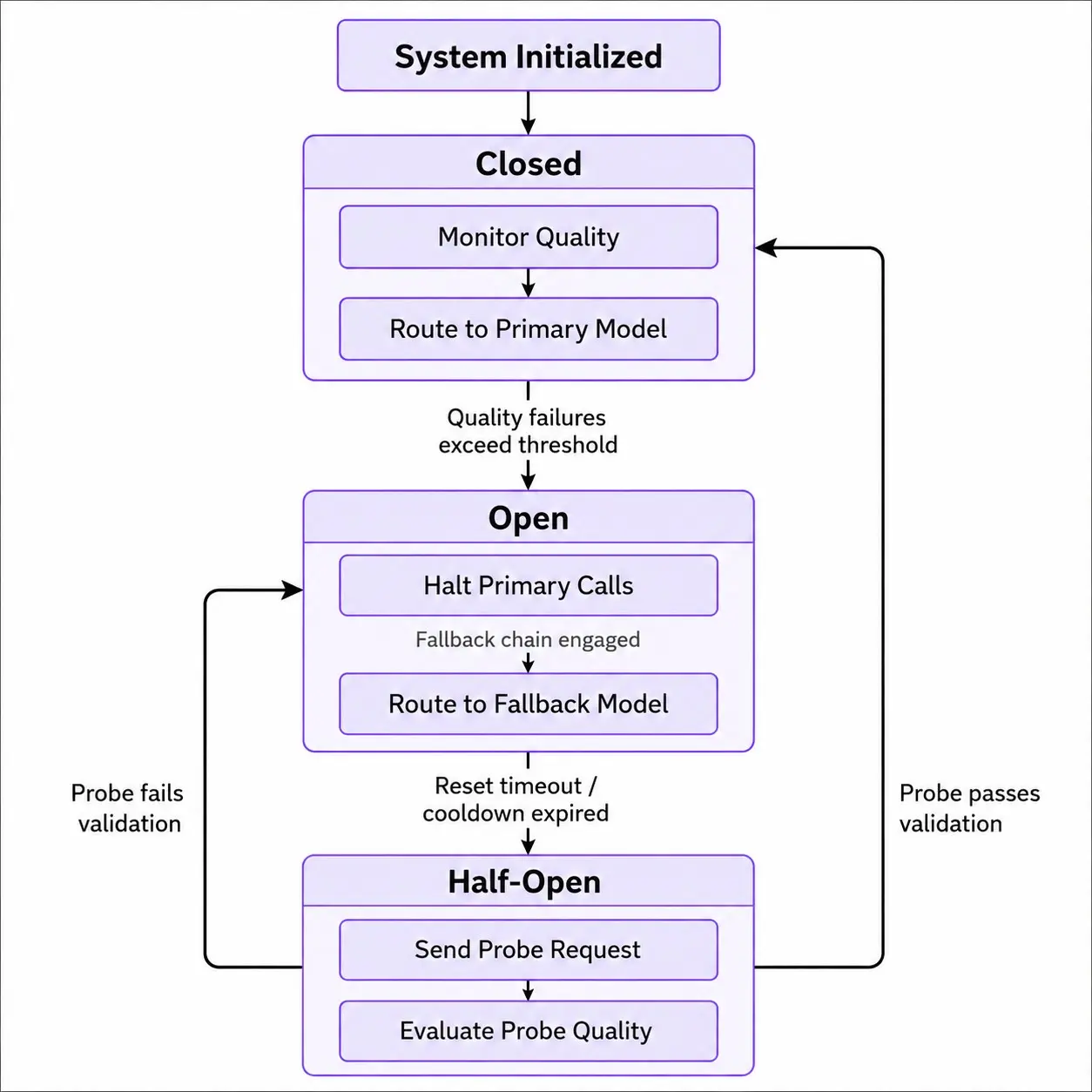
- consumption of tokens on a failing system. The system triggers a model fallback chain, automatically downgrading execution to a more stable model configured with strict temperature settings, structured schema enforcement, and restricted tool access.
- Half-Open State: After a configurable reset cooldown period, the circuit
- transitions to a Half-Open state and permits a single probe request. If this request passes schema and quality validations, the circuit is closed, and normal operations resume. If the probe fails, the circuit returns to the Open state, re-routing traffic to the fallback model and alerting the engineering team.
Idempotent Sagas (Checkpoint-Then-Execute)
To resolve partial failures in multi-step workflows without leaving downstream databases in a corrupted, half-written state, the orchestrator must implement the Saga Pattern. This pattern dictates that every write action must be treated as a transaction that includes three distinct components:
- Durable State Checkpointing: Before a tool is executed, the orchestrator records the transaction status, like pending, completed, or failed, in a durable, centralized checkpoint database.
- Idempotency Guarantees: Every tool call must accept and enforce an idempotency key. If a transient network failure occurs mid-transaction and the orchestrator retries the step, the downstream tool adapter reads the idempotency key, recognizes that the task was already processed, and returns the cached result rather than executing a duplicate write.
- Compensation Actions: Every tool that modifies state must define a corresponding rollback or compensation action. If step four of an eight-step workflow fails and cannot be resolved through retries, the orchestrator stops the sequence, marks the execution as failed, and reads the checkpoint database. It then executes the corresponding compensation actions in reverse order, such as deleting newly created records or reversing financial holds, to return the enterprise systems to their original states.
10. A Practical Production-Readiness Checklist
Before an agent is approved to transition from prototype to production operation, the system architecture must be audited against this 10-point production-readiness checklist:
Production-Checklist
| # | Category | Specific Engineering Verification Criteria | Technical Verification Method |
| 1 | Orchestration | Confirm that the primary workflow flow-control is governed by a deterministic state machine rather than model-directed reasoning. Verify that all tool calls utilize strict, statically typed validation schemas. | Code audit confirming that state transitions are hardcoded inside the system control plane, returning 0% unmapped transitions under error states. Unit tests passing invalid argument types to confirm that the tool adapter rejects the execution at the boundary with a 100% rejection rate. |
| 2 | Data & RAG | Implement sparse-dense hybrid search and cross-encoder re-ranking inside the retrieval pipeline. Establish source-level data data-governance, recency scoring, and eviction policies for stateful memory writes. | Benchmark testing candidate document retrieval accuracy using a validated golden evaluation dataset. Simulate conflicting write queries to confirm that outdated facts are programmatically evicted, preventing memory duplication. |
| 3 | Security | Assign a unique workload identity to each agent version and restrict data access using delegated access tokens. Deploy an Enterprise Model Context Protocol (MCP) Gateway to filter tool lists and inspect execution arguments at the API boundary. | OAuth configuration validation and automated permission testing on the credentials to ensure least-privilege compliance. Red-team testing simulating prompt injections designed to invoke unassigned tools, resulting in a 0% discovery rate of unauthorized tools. |
| 4 | Human-In-The-Loop | Implement hardcoded action-risk gates that route all Tier 4 (Irreversible) actions to synchronous human approval queues. Utilize durable execution serialization to pause workflows during manual reviews. | Workflow trace audits showing that the orchestrator blocks execution until human sign-off is committed in the database. Run end-to-end trials with extended manual review delays to confirm that workflow state is preserved without network timeouts. |
| 5 | Observability | Instrument trace capturing across all logic, planning, and tool execution layers. | Verification of OpenTelemetry export traces under high execution concurrency to ensure 100% visibility into parameters. |
| 6 | Resiliency | Configure Quality-Aware Circuit Breakers to detect semantic regressions and trigger model fallback chains. | Inject malformed JSON outputs into mock model responses to verify that the circuit transitions to Open in under 50 milliseconds. |
Moving Beyond the Sandbox
Transitioning an AI agent from a successful sandbox demonstration to a dependable enterprise system is not a model optimization problem, it is a rigorous systems engineering discipline.
The sandbox illusion, where clean data and constrained pathways suggest a level of system reliability that vanishes in production, can be entirely mitigated. By establishing a clear separation of concerns, where the orchestrator governs flow control deterministically and the model is used strictly for bounded decision-making, implementing an additive security posture, like workload identities and session proxies, and deploying robust exception-handling frameworks, like quality-aware circuit breakers and idempotent sagas, enterprise organizations can successfully deploy AI agents that are secure, observable, measurable, and highly dependable.
Whether your organization is seeking to design these controls from scratch or migrate existing pilot projects, our Custom AI Engineering, Managed AI Services, and Cloud Runway offerings provide the expertise, operational governance, and infrastructure needed to deliver resilient, production-grade agentic automation.
The era of the vibe-coded chatbot is over. The era of the dependable, engineered agent has begun.

Leave a comment
Your email address will not be published. Required fields are marked *







© 2025 EC Group. All rights reserved.